info@biomedres.us
+1 (502) 904-2126
One Westbrook Corporate Center, Suite 300, Westchester, IL 60154, USA
Site Map
 ISSN: 2574 -1241
ISSN: 2574 -1241
ISSN: 2574 -1241
Received: June 19, 2017; Published: July 03, 2017
Corresponding author: Mohamed El Kassem Mohamed Hassouna, Chemistry Department, Faculty of Science 62514, Beni-Suef University, Beni-Suef , Egypt
DOI: 10.26717/BJSTR.2017.01.000164
An indirect method has been developed for the determination of rosuvastatin calcium (RSC) in its pure form and in tablet formulations. It depends on the oxidative destruction of RSC using the oxygen flask technique or through combustion in a muffle furnace. The resulted Ca oxide after combustion is dissolved in 0.1N nitric acid and is determined by flame atomic absorption after appropriate dilution at 422.7 nm. The method succeeded in the determination of RSC in its pure form, where recoveries in the range 99.2-101.6 have been obtained, but failed in the determination of tablet formulations due to the interference of the other metals contained in inactive ingredients and excipients. Essential modifications have been introduced on the classical Schöniger method concerning the weight taken, volume of the combustion flask, volume of the absorption soln. and the flushing time which enabled the combustion of much larger weights. Further studies are under development to extend the application of the method for tablet formulations determination.
Keywords: Rosuvastatin Calcium; Indirect determination ; Oxygen flask ; Flame atomic absorption ; Calcium
Abbreviations: RSC: Rosuvastatin Calcium; OF: Oxygen Flask; DSC: Differential Scanning Calorimetry
Rosuvastatin calcium, is a cholesterol lowering drug commonly referred to as “statins”, was approved for the treatment of dyslipidemia [1-3]. Rosuvastatin calcium (RSC) is chemically bis [(E)-7-[4-(4-fluorophenyl)-6-isopropyl -2- [methyl - (methyl sulfonyl) amino] pyrimidin-5-yl] (3R, 5S)-3, 5-dihydroxy hept- 6-enoicacid] calcium salt (Figure 1). It is a synthetic lipid lowering agent, selective and competitive inhibitor of 3-hydroxy-3- methylglutaryl coenzyme A (HMG CoA) reductase, the key ratelimiting enzyme of cholesterol biosynthesis in liver.
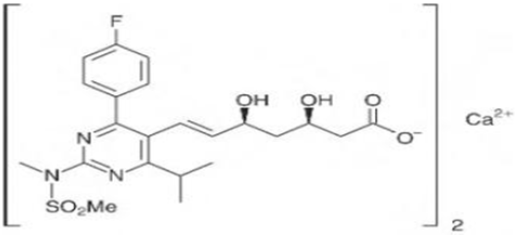
Figure 1: Chemical structure of Rosuvastatin calcium.
ROS is used to reduce the amounts of LDL cholesterol, total cholesterol, triglycerides and a lipoprotein B in the blood. ROS also increases the level of HDL cholesterol in the blood. These actions are important in reducing the risk of atherosclerosis, which in turn can lead to several cardiovascular complications such as heart attack, stroke and peripheral vascular disease. The empirical formula for rosuvastatin calcium is (C22H27FN3O6S) 2Ca and the molecular weight is 1001.14.Due its proved importance, the available literature reveals that Rosuvastatin Calcium (RSC) has been determined by different analytical techniques. Spectrophotometric [4-15], thin layer chromatography (TLC) [16], capillary electrophoresis [17], mass spectrometry [18-24], liquid chromatography (HPLC, UPLC) [25-51], electrochemical methods [52,53] and complex metric titration [54]. All of the previously published methods are direct ones.
The Schöniger flask or famously known as oxygen flask method( OF) [55] is a well proven technique for the combustion and then subsequent analysis of a range of elements including Chlorine, Bromine, Iodine, Fluorine and a number of metals. The combustion of the sample is a simple procedure and involves placing a few milliliters of absorbent solution in a flask. The sample is weighed out and placed in an ashless filter paper holder which in turn is placed in platinum gauze attached to the stopper of the flask. The flask is filled with oxygen and the stopper is then placed in the flask. The sample is combusted and the resultant combustion products are absorbed into the solution (Figure 2). The technique chosen for the actual determination of the element in question can be any one of a number of different techniques i.e. titration, spectrophotometry, ion chromatography, etc. The Schöniger flask combustion method is capable of being used for the determination of percentage levels to parts per million. It can cope with a wide range of sample types and is simple to set up with minimal start up costs. Besides, the OF Combustion Unit is a safe and repeatable method of igniting the samples when using the Schöniger procedure.
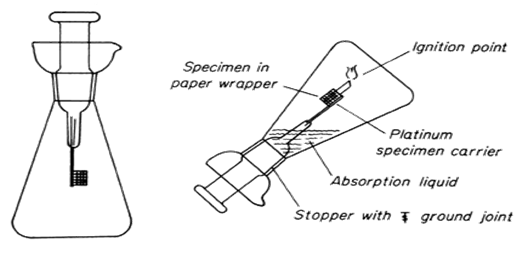
Figure 2: The Oxygen Flask technique.
The present research work describes an indirect method for the estimation of rosuvastatin calcium in its pure form and in tablet formulation forms, through determination of its attached calcium atom after the oxidative destruction of the organic moiety using the oxygen flask technique beside others. The method is rapid, accurate, sensitive and reproducible.
Nitric acid: analytical grade and double distilled water
Rosuvastatin Calcium is kindly supplied by SPIMACO Pharmaceutical Company, Alexandria, Egypt with claimed purity of 100.5%. The content of Rosuvastatin Calcium in BP Pharmacopeia is in the range 97.0 to 102.0 percent.
Six pharmaceutical preparations viz., Cholerose 10 mg Tab, Crestore 10 mg Tab, Estero-map 10 mg Tab, Advochol 10 mg Tab, Justechol 10 mg Tab and Crestolip 10 mg Tab are purchased from the local Egyptian market. Each tablet is claimed to contain 10.4 mg of Rosuvastatin Calcium.
Flame Atomic Absorption Spectrophotometer AA 240FS, Agilent Technologies, used for rapid and conformational determination of Ca; pH meter : microprocessor pH meter BT 500 BOECO, Germany, muffle furnace and 1L oxygen flask with Pt gauze sample holder.
0.075gm of the pure drug claimed to contain 3 mg Calcium (Ca) is transferred to a crucible and heated for 3 hours at 800oC . The sample is expected to turn to Ca oxide. The resulted oxides are dissolved in 0.1M nitric acid and quantitatively transferred to 25 mL measuring flask with rinsing of the crucible and completion to the mark with 0.1N nitric acid. The concentration of Ca in the flask is calculated to be 120μg per mL. An aliquot is diluted to obtain a solution contains12μg per mL of Ca. This solution is measured using an atomic absorption spectrophotometer.
The combustion step: In a weighing stick, weigh accurately 76-128 mg of Ros-Ca which is equivalent to 3-5 mg of Ca element content. Transfer onto the conventional L-shaped ashless filter paper. Fold the latter and fix it to the platinum gauze sample holder. Charge the 1L flask with 25 mL 0.1N HNO3 soln. Flush with oxygen, at a suitable rate, for 3 min., then combust as usual. The resulted solutions, after combustion, are quantitatively transferred to 50 mL measuring flasks and completed to the mark with 0.1 N nitric acid soln. These solutions are expected to contain 60.8 μg - 100.8μg per mL Ca respectively. Dilution is carried out to obtain solutions of ≈12μg per mL of Ca. These solutions are directly aspirated and measured using the atomic absorption spectrophotometer.
Weighed and transferred 10 tablets into a mortar and made a fine powder. Aliquots of the powder are weighed in a similar range for both decomposition by the oxygen flask or the muffle furnace.
The concentration of the free Ca in the solution is directly measured at λmax equals 422.7 nm with detection limit of 50μg/L using a mixture of Acetelyne – Nitrous Oxide flame.
To carry out the idea of indirect determination of RSC, we firstly tried the mineralization process of the drug through simple evaporation of its concentrated nitric acid solution in a beaker over a hot plate till near dryness, but this procedure failed to achieve decomposition. Reflux of the drug’s nitric acid soln. for 3 hrs. failed, also to realize decomposition. Hence, the thought was directed towards the use of more efficient method for the oxidative destruction of RSC. We recalled the oxygen flask method of Schöniger [55] that has proved its potentiality as an elegant mineralization method. Our last application of it was about 20 years ago [56] where we used it for the successful decomposition of organo calcium compounds. Parallely, we combusted samples of RSC contained in porcelain crucibles in the muffle furnace at 800oC for three hrs. As a conformational procedure both last gave gave quantitative calcium results, where each determined calcium atom is equivalent to two molecules of rosuvastatin. Good results have been obtained with the pure active ingredient (Table 1), but, unfortunately and surprisingly, erroneous inconsistent results are obtained with all the tested tablet formulations.
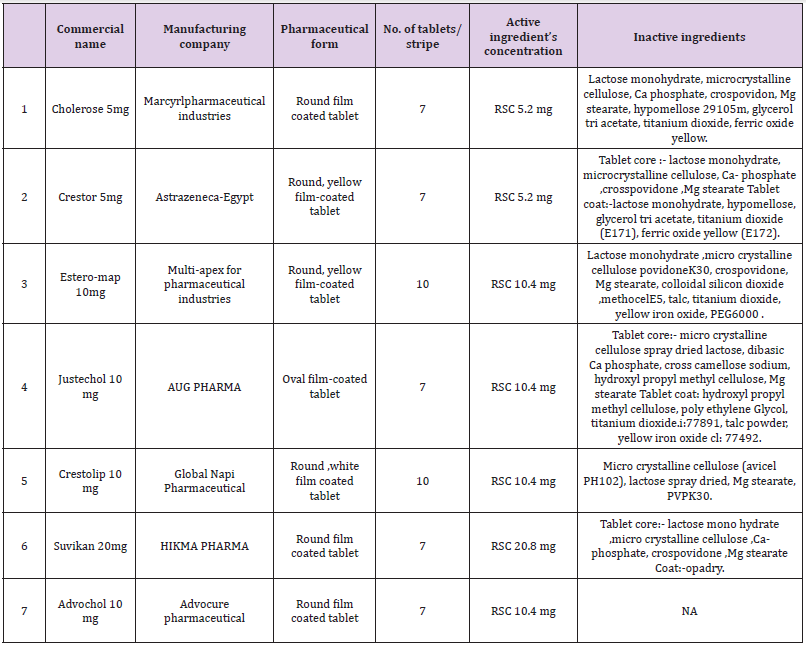
This surprise has been dissipated on examining the group of active ingredients and excipients accompanying RSC in each of the tested tablet formulations. (Table 2) shows the presence of a number of metal salts and oxides, e.g., Ca phosphate , Mg stearate , titanium dioxide(E171) ,ferric oxide yellow(E172) and colloidal silicon dioxide are included side by side with RSC. On combustion by either method these elements interfere seriously with Ca.
Table 1: Indirect determination of RSC after combustion in oxygen flask and muffle furnace.
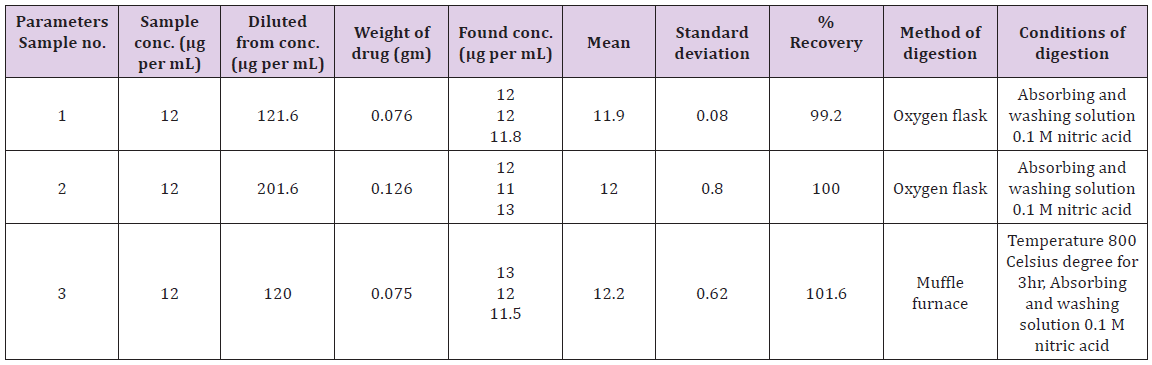
Table 2: List of assayed pharmaceutical preparations and their inactive ingredients content.
The stability of RSC and the encountered difficulty in its decomposition is verified by the forced degradation studies as acidity, alkalinity, oxidation, heat and photo degradation which are performed in our recent HPLC study [51] according to ICH guidelines [57]. Also, the DSC data of pure RSC [58] show the endothermic peak at 156.47oC of the pure RSC where there was no sharp change in melting point of the drug and indicate the melting point value (122 oC) which was reported in literature.
Although the present method has succeeded only for the determination of RSC in its pure form and failed to be applied for the determination of its concentration in tablet formulations due to the causes illustrated in (Table 2), however the method is considered the first indirect one for its determination through its chelated Ca atom besides it comprises essential modifications introduced on the classical Schöniger method concerning the following:
a) Weight taken: The classical technique deals with weights in the range 3-5 mg, here we combusted, safely, more than twenty times large weights in the range 76-126 mg, to compensate the low Ca ratio relative to the large MW (1001.14) of RSC.
b) Volume of the combustion flask: The former modification necessitated the use of 1L Erlenmeyer flask instead of the classical 250 mL or 500 mL flasks.
c) Volume of the absorption soln: The classical 5 mL absorbent soln. has been increased to 25 mL to absorb and dissolve the combustion products of such larger weights.
d) Oxygen flushing time: Has been increased from 1 min. to 3 min. to supply the sufficient quantity of oxygen for achieving complete combustion.
To extend the application of the proposed method to the determination of tablet formulations, further work is planned, in the near future, to be applied on the soln. after combustion, based on the use of highly selective colorimetric reagent for Ca in the presence of efficient masking agents for the other interfering elements that are present in the inactive ingredients illustrated previously.
An indirect method has been developed for the determination of RSC through its chelated Ca atom after decomposition by the oxygen flask and /or the muffle furnace. Essential modifications have been introduced on the classical Schöniger method concerning the weight taken, volume of the combustion flask, volume of the absorption soln. and the flushing time.
The authors are thankful to the Committee of the Biomedical Journal of Scientific & Technical Research for the publication gift provided.

International Association of Landscape Archaeology, Czech Glass Society, Czech Republic

Department of Chemistry, Semenov Institute of Chemical Physics, USSR Academy of Sciences, Moscow, Russia

Department of Educational Sciences, Research Centre Qualities of Teachers, School of Education – HAN, Nijmegen, Netherlands

Associate Professor at Department of Breast and Thyorid Surgey, Chongqing General Hospital, China

Neurology, LA BioMed Research Institute, USA





 Abstract
 PDF
PDF



























